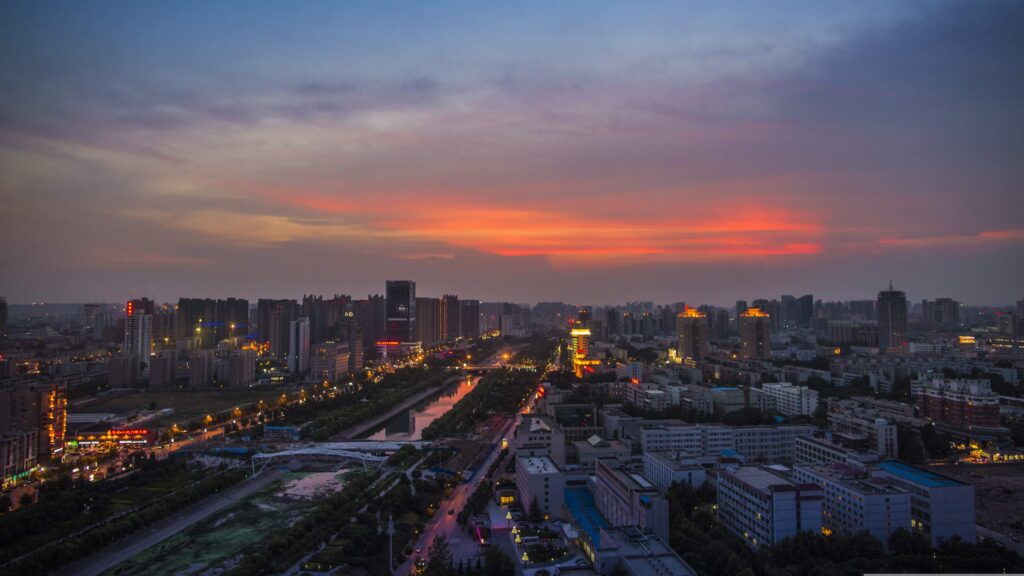
When discussing Zhengzhou, it is often portrayed as a major railway hub, an agricultural heartland, or a key logistics platform. For years, the city carried the image of a traditional inland center, seemingly lagging behind in high-tech innovation and digital transformation. However, a closer look reveals a quiet yet profound shift: Zhengzhou has evolved from a largely passive development model to a more collaborative and in some areas, distinctly innovative approach.
By 2026, Zhengzhou is no longer defined solely by its demographic strength or its role as a transportation node. At the core of its transformation lies a fully integrated “urban brain” that is reshaping city governance. By leveraging data flows, the city is optimizing mobility, streamlining logistics, and enhancing capital circulation. This is not merely a technological upgrade, but a structural transformation of the city’s operational DNA.
A transformation accelerated by climate challenges
Zhengzhou’s smart city evolution is the result of long-term strategic planning. Early in the 14th Five-Year Plan, the city introduced the concept of “one brain for the city, one network for the entire territory,” prioritizing data integration from the outset. Unlike many cities that initially struggled with fragmented systems, Zhengzhou focused on breaking down data silos.
The establishment of a dedicated Big Data Administration elevated data to a strategic asset. Through a unified municipal cloud platform and cross-departmental data-sharing systems, the city had aggregated over ten billion data points by the end of 2025, spanning key sectors such as transportation, healthcare, education, and social services. This comprehensive data visibility enables real-time monitoring of urban operations, much like a digital control dashboard.
Extreme weather events in 2024 further accelerated this transition. Zhengzhou strengthened its resilience strategy by deploying an intelligent flood prevention system that integrates meteorological, hydrological, and urban planning data. Supported by artificial intelligence, the system enables a shift from reactive disaster response to proactive risk prediction.
Technology embedded in everyday life
The true value of a smart city lies in its impact on daily life and in Zhengzhou, this impact is tangible.
In urban mobility, the “City Brain – Transportation Edition” optimizes traffic flow without relying solely on infrastructure expansion. In districts such as Zhengdong and Jinshui, adaptive traffic signals adjust in real time based on traffic conditions, increasing average speeds during peak hours by more than 15%. Meanwhile, the “One Network for Parking” initiative connects tens of thousands of parking spaces to a centralized cloud system, allowing users to locate, navigate to, and pay for parking via mobile devices.
In public services, the “Zheng Bang Ban” application has become an essential digital gateway. From business registration to civil services, nearly all administrative procedures are accessible online. By promoting paperless processes and electronic certification, Zhengzhou has achieved close to full digital availability of public services, significantly improving both user experience and the business environment.
The city is also advancing in healthcare and community services. Through interoperable medical data systems, telemedicine is now widely available across district-level hospitals, enabling access to high-quality care locally. In parallel, the digital upgrading of older residential areas—with smart access control and support systems for elderly residents demonstrates a people-centered approach to technology deployment.
Zhengzhou and Wuhan: two complementary models
A comparison with Wuhan provides valuable perspective. Wuhan, home to the renowned Optics Valley and a dense network of universities, excels in technological research and development. Its smart city model is driven by advanced innovation in artificial intelligence, semiconductor development, and industrial internet platforms.
Zhengzhou, by contrast, has adopted a more application-oriented approach. Rather than focusing primarily on developing core technologies, it integrates and scales existing solutions, particularly in logistics. Its multimodal transport data platform, developed within the airport economic zone, enables end-to-end visibility and intelligent coordination across supply chains—achieving a level of digitalization that, in certain areas, surpasses Wuhan.
Governance also differs. While Wuhan’s model is closely tied to its industrial and research ecosystem, Zhengzhou emphasizes urban management and public service delivery for a large population base. Its “network + digital” governance model is characterized by high responsiveness and operational efficiency, particularly in areas such as mobility management and local service provision.
Additionally, Zhengzhou has demonstrated strong institutional capacity in data integration. By overcoming administrative barriers, it has achieved citywide data centralization, giving it a competitive edge in emergency response and strategic decision-making.
Challenges ahead
Despite its progress, Zhengzhou faces several challenges. Ensuring data security and protecting privacy are critical as data volumes continue to grow exponentially. Bridging the digital divide is equally important, particularly to ensure that elderly and low-income populations fully benefit from digital services.
Another key issue is the sustainability of its operational model. Moving beyond a predominantly public investment framework toward a more market-driven approach, with increased private sector participation, will be essential for long-term scalability.
Toward an era of intelligent governance
Looking ahead, Zhengzhou is positioning itself as a regional computing hub, supported by the development of national computing infrastructure nodes. The next phase of its smart city evolution will go beyond data connectivity, integrating artificial intelligence into decision-making processes.
From traffic forecasting and urban planning simulations to personalized education and precision healthcare, AI-driven applications are expected to play an increasingly central role. Zhengzhou’s trajectory points toward a more predictive, adaptive, and intelligent urban system.
Ultimately, Zhengzhou’s strength lies in its pragmatic approach. Rather than pursuing technology for its own sake, the city focuses on solving real urban challenges and improving quality of life. In doing so, it demonstrates that smart city success is not limited to top-tier metropolitan areas such as Beijing or Shanghai.
Zhengzhou offers a compelling model: one where effective implementation, strategic positioning, and citizen-centric innovation define the future of urban development.
Source : https://news.qq.com/rain/a/20260317A05NRL00
About The Author