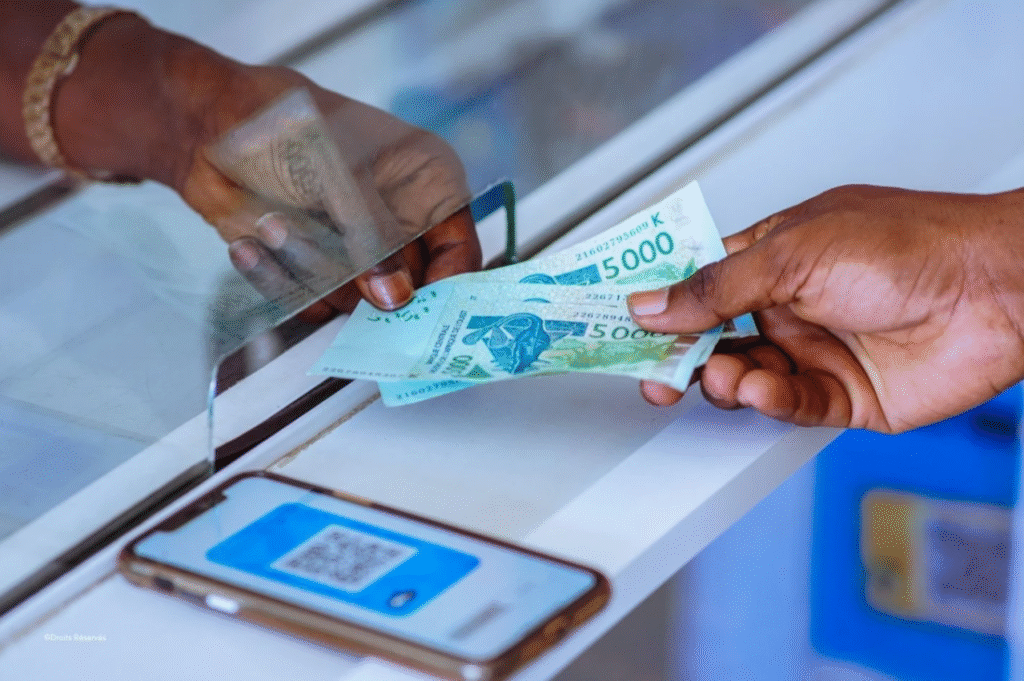
Long hailed as the continent’s most inclusive financial innovation, mobile money continues to demonstrate strong growth across Africa. In 2025, nearly $1.432 trillion flowed through mobile money accounts on the continent, representing an increase of approximately 27% compared to 2024, according to The State of the Industry Report on Mobile Money 2026, published on March 24 by the GSMA.
Africa accounted for nearly 66% of the global transaction value, which reached $2.091 trillion (+23% year-on-year). Out of a global total of 125 billion mobile money transactions, the continent represented about 74%, equivalent to nearly 92 billion transactions (+16% compared to 2024).
Furthermore, the report highlights that Africa hosts 52% of mobile money accounts worldwide. By the end of 2025, the continent had approximately 1.2 billion accounts (+18% year-on-year), including 347 million active monthly accounts, out of a global total of about 2.3 billion accounts (+13%), with 593 million active within 30 days. Africa therefore remains the epicenter of mobile-based finance. However, this success reveals an increasingly visible contradiction: while the service is expanding rapidly, its full adoption and real impact on populations remain constrained.
Barriers to Inclusion
The first barrier is material. The World Bank notes that 84% of adults in developing countries own a mobile phone, yet about a quarter still use basic devices more affordable but limited in functionality and lacking internet access. Only two-thirds of adults own a smartphone capable of accessing applications and browsers. In Sub-Saharan Africa, this figure drops to 33%. The primary reason cited for not owning a smartphone remains its cost. The International Telecommunication Union (ITU) similarly identifies affordability particularly of devices as a major obstacle to digital adoption across the continent.
The second barrier is cognitive. The GSMA’s 2026 report clearly identifies low levels of digital financial literacy as a major constraint. In countries where adoption gaps persist, the figures are striking. In Ethiopia, among those aware of mobile money but without an account, 60% of women and 54% of men report not knowing how to use the service; 45% of women and 50% of men struggle with using a phone or fear making mistakes. In Egypt, this barrier affects 21% of women and 15% of men, while in Nigeria it affects 22% of both women and men. Equipment constraints also play a role: in Ethiopia, 24% of women surveyed cite the lack of a SIM card or phone as a key barrier.
Beyond a Service: A Human Impact Challenge
The paradox is clear: mobile money initially thrived on basic mobile phones. Today, however, its next phase requires more advanced tools. Use cases have expanded significantly, with service providers increasingly relying on super apps rather than USSD codes to deliver greater value: bill payments, government social transfers, micro-insurance, microcredit, and micro-savings.
The fastest-growing segments are merchant payments, which rose by 42% to $155 billion in 2025, and interoperable transfers between banks and mobile wallets, totaling $167 billion. In other words, the sector has moved beyond simple peer-to-peer transfers and entered a more sophisticated phase, where users must navigate interfaces, QR codes, virtual cards, security protocols, and transaction verification. Without appropriate devices and basic digital skills, a significant portion of the population risks being confined to the most basic uses, while the ecosystem evolves toward more complex services.
This divide also has a social and gender dimension. Without access to adequate devices and digital skills, millions of Africans remain excluded from the full benefits of mobile money. In low- and middle-income countries, GSMA estimates that women are 14% less likely than men to use mobile internet, leaving 885 million women offline, nearly 60% of whom live in South Asia and Sub-Saharan Africa. This raises the risk of a two-tier financial inclusion system, unevenly distributed in practice.
Unlocking the Full Potential
Unlocking the full potential of mobile money in Africa requires more than commercial expansion. The response must be industrial, educational, and regulatory. The ITU advocates for more affordable entry-level smartphones, facilitated purchasing through microcredit or installment payments, and lower costs for devices and data. It also calls for the integration of basic digital skills into education systems and training programs.
Similarly, GSMA emphasizes the importance of targeted digital financial literacy initiatives, particularly for women, rural populations, and older adults. The World Bank underscores that cost, usability, and security must be addressed simultaneously.
Ultimately, the real challenge for Africa is no longer to prove that mobile money works, but to ensure that everyone can truly use it.
About The Author