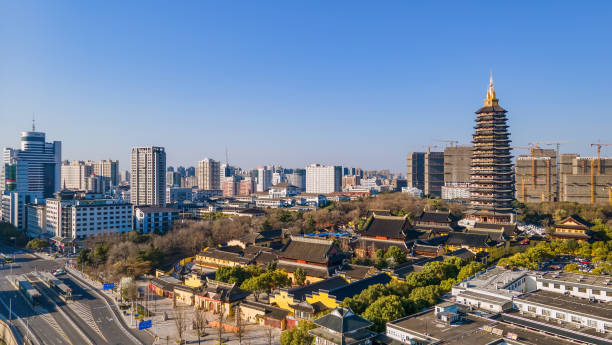
Aerial view of Hongmei Park, Wenbi Tower and Tianning Temple scenic spot in Changzhou, Jiangsu Province, China
Urban public transportation, a cornerstone of collective well-being and territorial development, is undergoing a profound transformation in Changzhou driven by artificial intelligence. The most emblematic example is the regional “Cloud Bus,” launched in the town of Menghe.
Introduced in late November 2025, this on-demand transport service quickly gained public acceptance. In just one month, it completed 3,781 trips and served 5,574 passengers, with average waiting times reduced to 339 seconds—and in some cases, as little as three seconds. Some users relied on the service more than 60 times in a single month, highlighting its rapid and widespread adoption.
Unlike traditional fixed-route services, the Cloud Bus operates on a flexible network that combines physical and virtual stops. Five-seat vehicles provide real-time optimized journeys through an intelligent ride-pooling system. As a result, 3,452 kilometers of unnecessary travel were eliminated in the first month alone, while the fleet size was dynamically adjusted from six to nine vehicles based on demand.
This performance is underpinned by the “Public Transportation Digital Brain,” a platform developed by Changzhou Public Transportation. By integrating public transport data with online mobility data, the system enables traffic flow analysis, network simulation, and intelligent vehicle dispatching. Since its launch, the Cloud Bus has achieved an 80 percent increase in daily ridership, reduced vehicle procurement costs by 7.2 million yuan, and cut more than 20,000 kilometers of redundant travel.
AI-driven innovation in Changzhou extends beyond bus services. In late 2024, the city introduced a quasi-free-flow intelligent toll station in the Wujing Economic Development Zone. Powered by “AI+” technologies, ETC-equipped vehicles now pass through toll gates without stopping, reducing transaction times from 350 milliseconds to under 30 milliseconds, with a success rate exceeding 99.9 percent. Overall traffic efficiency at the site has improved by approximately 80 percent.
For non-ETC vehicles, automated card dispensers and payment robots supported by intelligent license plate and axle recognition have shortened waiting times by 10 to 20 percent. In addition, remote management of special cases through cloud-based control stations has reduced on-site manual interventions by 33 percent.
In September 2025, Changzhou took a further step by releasing the Implementation Plan for “Transportation + Artificial Intelligence” Demonstration Scenarios (2025–2027). The initiative includes ten pilot projects spanning highways, public transportation, ports and waterways, railways, and transport law enforcement.
By combining strategic foresight with rapid deployment, Changzhou is shaping a mobility model that is more fluid, people-centered, and intelligent. The city is now fostering a virtuous cycle linking technological innovation, real-world application scenarios, and industrial development, positioning artificial intelligence as a long-term driver of high-quality urban growth.
Source : https://www.changzhou.gov.cn/ns_news/196176705543323
About The Author