Artificial intelligence: a potential of $1 trillion for African GDP by 2035 (Report)
 La rédaction
3 min read
La rédaction
3 min read

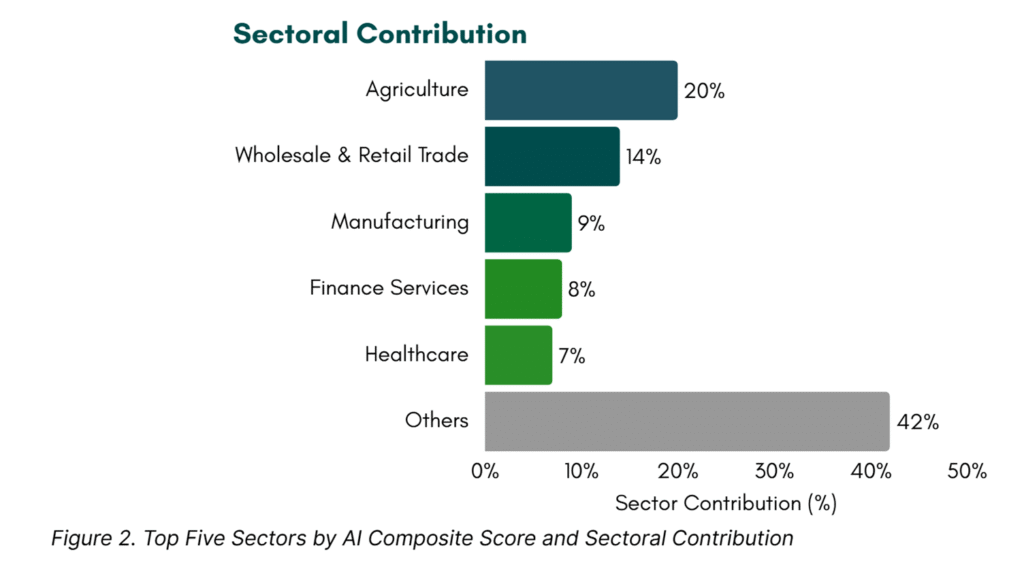
The report highlights that several key economic sectors are expected to capture the bulk of productivity gains resulting from the large-scale deployment of artificial intelligence across Africa. These include agriculture, wholesale and retail trade, manufacturing, finance and financial inclusion, as well as health and life sciences.
According to a study published on December 12, 2025, by the African Development Bank, an inclusive adoption of AI could generate up to $1 trillion in additional value for Africa’s GDP by 2035. This would represent nearly one-third of the continent’s current economic output, driven primarily by significant productivity improvements across strategic industries.
Titled “Africa’s AI Productivity Gain – Pathways to Labour Efficiency, Economic Growth and Inclusive Transformation,” the report describes this opportunity as both realistic and achievable. It is underpinned by Africa’s expanding digital capabilities, favourable demographic trends, and ongoing sectoral reforms. The authors outline three possible trajectories for the continent’s AI development through 2035.
The first scenario, which assumes a continuation of current trends, would lead to modest productivity gains of around $250 billion, with limited effects on employment. The second scenario, referred to as “fragmented progress,” could generate between $500 and $600 billion in productivity gains, though positive labour-market impacts would remain concentrated in only a handful of countries. The most ambitious scenario, labelled “full activation,” has the potential to unlock the full $1 trillion opportunity, create between 35 and 40 million digital-related jobs, and ensure broad sectoral and regional coverage.
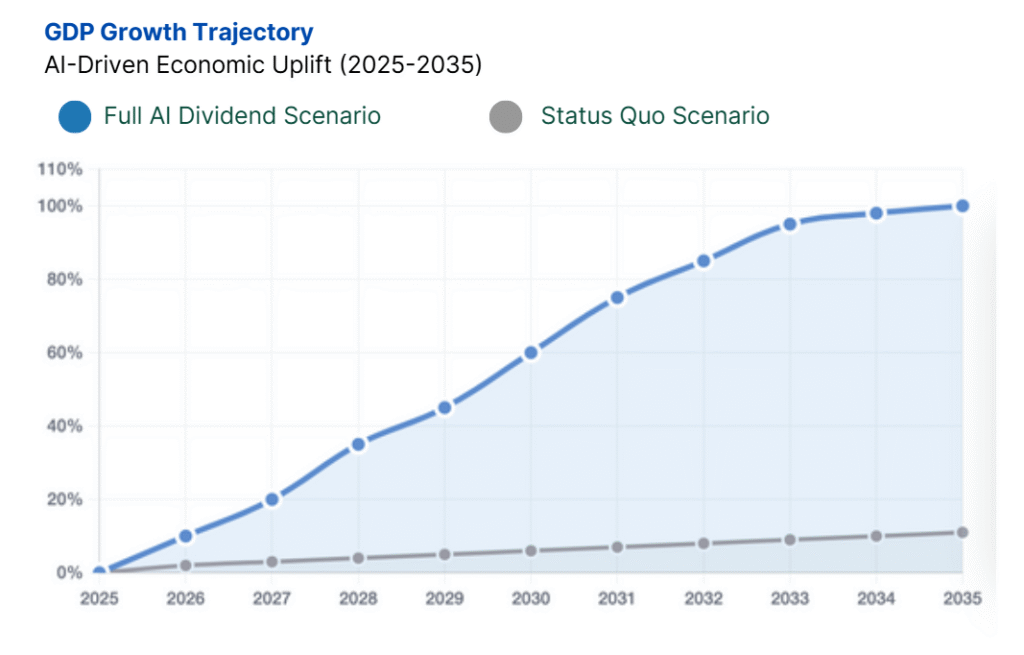
However, the report stresses that Africa’s ability to fully benefit from AI-driven productivity gains depends on five interconnected pillars: computing power, data availability, human skills, trust, and capital. Reliable and interoperable data systems are essential for effective AI applications, while scalable computing infrastructure is a prerequisite for widespread deployment. A skilled workforce will be critical for developing and maintaining AI systems. At the same time, trust—supported by strong governance and regulatory frameworks—will be vital to encourage adoption. Significant financial resources will also be required to build infrastructure, reduce investment risks, and accelerate innovation.
On the infrastructure front, the continent is expected to establish six regional data hubs equipped with advanced GPU processing capacity, governed under an African Union charter. In parallel, around 60 national and regional open-data platforms aligned with FAIR principles should be developed across Africa’s regional economic communities. The report also estimates that approximately three million professionals will need to be trained for AI-related occupations.
In addition, a continent-wide legal framework for managing AI-related risks should be adopted at the African Union level and implemented by more than 20 African countries to strengthen confidence in the technology. The report further calls for the mobilisation of nearly $10 billion in blended finance, coordinated through the African Fund for Growth and Innovation in AI.
Produced by consulting firm Bazara Tech within the framework of the G20 Digital Transformation Working Group, the report also proposes a three-phase roadmap to translate Africa’s AI potential into tangible outcomes. The initial “ignition” phase, spanning 2025 to 2027, focuses on establishing policy frameworks, launching pilot projects, and initiating investments in computing infrastructure. The subsequent “consolidation” phase, from 2028 to 2031, aims to develop regional corridors for data and computing while strengthening skills and capital mobilisation. The final phase envisions scaling AI capabilities across all regions and economic sectors.
The report also notes that African countries do not share the same level of readiness for AI adoption. It groups them into four categories: “catalysts,” such as Nigeria, Kenya, and South Africa; “accelerators,” including Ghana, Morocco, Tunisia, and Côte d’Ivoire; “innovation hubs,” such as Rwanda and Mauritius; and “foundation builders,” which require significant support to develop core digital capacities. Bridging these gaps will be essential to avoid a two-speed AI transition across the continent.
Finally, the report underscores that productivity gains will not be evenly distributed across industries. Five high-potential sectors are expected to capture 58% of total AI-driven dividends: agriculture and food systems, wholesale and retail trade, manufacturing and Industry 4.0, finance and financial inclusion, and health and life sciences. Together, these sectors could account for approximately $580 billion in gains by 2035. Meanwhile, other industries, though less prominent, still represent a substantial opportunity valued at $420 billion. In energy, AI could enhance demand forecasting, optimise smart grids, and detect failures before they spread. In transport and logistics, it could enable real-time traffic management, intelligent route optimisation, and predictive maintenance to extend asset lifespans.
About The Author