01 Keywords in China’s Domestic ITS
Large Models
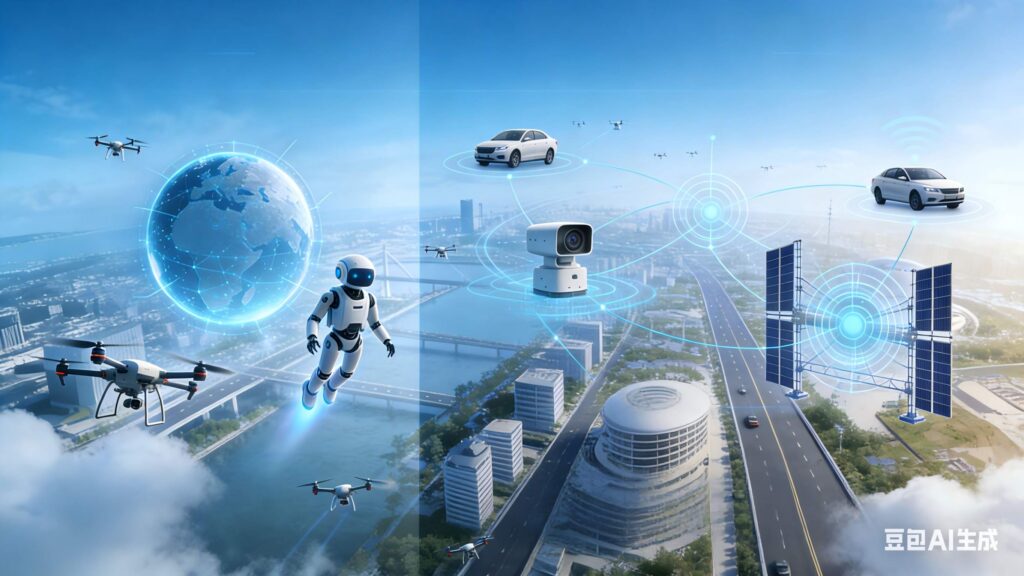
Starting with DeepSeek igniting the large model trend, and even as some rationality gradually returned, large models remained an unavoidable hot topic in the intelligent transportation field in 2025. From the Road Traffic Safety Products Expo in the first half of the year, large models permeated multiple areas of ITS—from basic detection technologies like video analytics to control and command capabilities, highway intelligence, and even various transport modes like road, rail, water, and air. Related releases were constant, with notable promotional success. Yet, a rainstorm or snowfall still led to congestion, accidents, and road closures… Perhaps, since traffic problems are not created overnight nor by a single cause, their solution cannot be achieved instantly or by a single method. May substance remain after the flourish fades.
Embodied AI Robots
Starting with robot performances at the Spring Festival Gala to AI robots directing traffic on roads by year’s end, it seemed like an instant leap from manual to intelligent. However, given the overall environment, how much such tools can truly contribute remains a big question mark for many. Gathering dust after the hype is often the fate of many technologies, yet innovation is unstoppable. Whether AI augments human capabilities or replaces them seems a question requiring answers not just from technology but from ethics, society, law, and more.
Drones
The use of drones in ITS didn’t begin in 2025, but under the raging trend of the low-altitude economy this year, their applications have been continuously explored. Uses span information collection, patrol monitoring, command dispatch, accident handling, and more. Some scenarios indeed show potential value. Hopefully, future development will be sustainable, achieving breakthroughs in ITS.
Vehicle-Road-Cloud Integration
Following the announcement in mid-2024 of 20 cities (or consortia) selected for the “Vehicle-Road-Cloud Integration” application pilot for intelligent connected vehicles, 2025 entered a phase of comprehensive pilot implementation. Faster-developing cities have even completed Phase 2 or 3 work. Investments often reaching billions of yuan have amounted to a new hotspot, injecting a stimulant into the somewhat sluggish urban ITS field. Although skepticism has grown due to unclear practical benefits, if implementation can refocus on solving actual traffic problems, reduce grand narratives, and identify precise, urgently-needed small-scale scenarios, it may still play a powerful role in addressing complex traffic issues. After all, there remains some distance between the goals of engineering projects and the exploration of scientific research. As for talk of “commercial closed loops,” these have long been elusive in many areas of ITS.
Digital Transformation
As traditional urban ITS investment tightens, digital transformation projects for road traffic infrastructure worth billions have become a new trend, even if ultimately mostly absorbed internally. This represents a significant step beyond the traditional three major electromechanical systems for highways. While its actual impact remains unpredictable, the direction of development should be affirmed. Informatization and intelligence should play their due role in improving traffic efficiency and safety. Hopefully, digital transformation can chart a good path that integrates the virtual and real.
02 Keywords in International ITS Development
This section is limited by impressions from visiting the ITS World Congress, etc.
LiDAR
One takeaway from the ITS World Congress is that existing traffic information collection technologies always seem to have shortcomings. Thus, this field is rapidly evolving—from radar and video to radar-video fusion. Recently, supported by factors like cost reduction, several companies focused on detection have begun exploring LiDAR’s application in road traffic monitoring. Given its unique technical advantages, it may become mainstream for certain scenarios in the future.
V2X
Judging by the atmosphere at the 2025 ITS World Congress, the enthusiasm for V2X seems beyond words. Advances in wireless communication, computing units, information collection, and more have removed fundamental technical barriers. Consequently, efforts around V2X are underway globally, even if names differ (similar to varying national names for ITS before 1994?). There’s a shared recognition of the importance of synergy between people, vehicles, roads, and even the environment, though concepts, starting points, and emphases differ. Careful comparison and reflection may be more enlightening.
SaaS
Software as a Service is not a new concept in ITS, having emerged alongside cloud computing. However, from developments noticed in 2025, the proportion mentioning SaaS has increased. In familiar areas like traffic management systems and traffic control systems, many companies mention the SaaS model, starting to offer equipment monitoring, data analysis, command and control functions via SaaS, potentially exploring a new path for efficiency gains.
Congestion Charging
Congestion charging is a classic example of using economic measures to regulate the supply-demand balance in traffic, hardly falling within the strict scope of ITS. However, 2025 saw New York City’s congestion charging stage a dramatic rollercoaster. By year’s end, Transport for London’s (TFL) announcement of future expected adjustments to its congestion charge fully demonstrated the application of market economic measures in traffic management. As the “tragedy of the commons” caused by free or low-cost access continually plays out in transportation, and constrained by infrastructure capacity limits, technology alone often cannot solve short-term supply-demand imbalances in specific areas. Perhaps we need to consider using economic measures more in the future.
Artificial Intelligence
Of course, this term has appeared in ITS for years, but by 2025, it was in full swing. Whether in research, industry, or any subfield of ITS, AI has become a must-mention topic, making its inclusion here somewhat like padding the list.
03 Keywords in the Broader Transportation Field
Intelligent transportation is only one direction within transportation, which encompasses far more than ITS itself. Hot topics in transportation in 2025 might include:
Public Transport
Since the post-pandemic struggle for recovery, by 2025, nearly all ground bus public transport in China fell into an almost unsolvable predicament. By year’s end, I’ve casually seen Beijing metro data showed: track length increased by nearly 200 km, yet daily passenger volume kept declining. The entire public transport system seems to be sinking into an inescapable quagmire. Factors like poor integration with land use, inconvenient transfers and slow speeds, constant encroachment by cars and e-bikes, and continuously declining economic returns… all seem to be straws breaking the camel’s back. Where public transport goes during the “15th Five-Year Plan” period is likely a question traditional thinking and approaches cannot answer.
Electric Bicycles (E-bikes)
The implementation of the new national technical standard for e-bikes at the end of 2025 and the unconventional/unusual design of some models pushed this already-controversial topic to a new peak. Since their inception, these vehicles and travel modes have been accompanied by safety, compliance, and violation issues. Various parties introduce policies from the angle of “for the good of travelers.” However, solving traffic problems often requires comprehensive social, economic, and technical measures. Well-intentioned but single-faceted efforts often yield half the result for twice the effort. Solving or alleviating e-bike issues still requires great wisdom.
Low-Altitude Economy
Placing this here in sequence might be somewhat inappropriate. The low-altitude economy was likely the hottest topic of 2025. The fact that universities sprang up like bamboo shoots after rain to establish programs from undergraduate to doctoral levels within a year rivals trends like “integrated circuits” and “AI.” Various research institutions, state-owned and private enterprises also came in succession. While Shenzhen’s aerial delivery serves as a leading example, the accidental close contact between two eVTOLs at the Changchun Airshow) served as a warning. Currently summarized application scenarios are numerous, but non-high-frequency scenarios that cannot be rapidly scaled likely cannot support a trillion-level industry. What will the U.S. release of its AAM National Strategy at the end of 2025 bring for the new decade?
Advanced Driver-Assistance Systems (ADAS)
This is not a new term, but 2025’s work involved clarifying what these terms actually mean. From the sudden surge of intelligent driving represented by various “9-series” models and new EV makers, leading consumers to mistakenly believe the era of driverless had arrived, to several major and minor accidents ultimately serving as warnings paid for with lives. National standards entered the scene to clarify the complex terminology—what constitutes unmanned driving, intelligent driving, assisted driving, etc.—to slightly decelerate the noisy, frenziedly speeding car market, preserving a shred of sober reason amidst the restless excitement. The start of L3 vehicle road tests at the end of 2025 indicates steady progress in related fields.
“Sharing Economy” (in quotes)
I use quotes because I have never considered so-called “ride-hailing” or “bike-sharing” to be true “sharing economies,” except for genuine carpooling. On one hand, platforms like Didi turned profitable, with continuously increasing revenues. On the other hand, “ride-hailing” and taxi drivers faced hardships and rapid turnover. Moreover, numerous other platforms kept eyeing the mobility market… As a fundamental livelihood area, transportation will undoubtedly remain under scrutiny. However, nominally labeled “sharing economies” will eventually awake from the dream: in this field, where is there any true “sharing”? It’s all business, just in different forms (Robotaxi is included here, not listed separately).
04 Predictions
Discussing only the past without mentioning the future seems incomplete. Yet, summarizing the past already feels somewhat unconstrained/fanciful, so speculating about the future falls even more into the category of wild imagination and presumptuous talk, offered here merely for your amusement.
Spatial Computing
“Spatial computing digitally enhances the physical world using technologies like augmented and virtual reality. It elevates interaction between physical and virtual experiences to a new level.”
Once, the transportation field used simulation to model the physical world, hoping to replicate it. Later, this one-way simulation became insufficient, leading to the promotion of digital twins. However, constrained by data limitations and core models, current digital twins seem not yet to have touched their core. In the future, spatial computing goes further, with AR, VR, AI, etc., deployed together to provide enhanced capabilities for digital twins. Can it create more immersive experiences?
Multifunctional Robots
“Multifunctional robots can perform multiple tasks. They are replacing single-task robots designed for repetitive execution of one specific task.”
Currently, there are already robots directing traffic on roads, but their functions seem too singular. Can more human-like multifunctional robots be realized in the future, capable of both civilian tasks like bringing peace through writing and martial tasks like securing the realm on horseback? Let’s wait and see.
Agentic AI (AI Agents)
In 2025, digital human assistants seemed to have permeated many scenarios, though their current capabilities are quite limited, with narration/explanation being a common application. Agentic AI “possesses autonomous or semi-autonomous decision-making and action capabilities,” and “optimizes decision-making processes and enhances organizational situational awareness through rapid data analysis and predictive intelligence.” In the future, perhaps building upon current large models, highly specialized Agentic AI may emerge to assist in traffic management, service provision, and decision-making.
Smart Wearable Devices
The recent emergence of smart glasses represents a new breakthrough for information acquisition in road policing. Smart glasses have been in development for over a decade but only seemed to reach an exploitable state in 2025. As more tech giants enter the field, will this become a new major market? In ITS, can smart glasses with more integrated functions suitable for different users—travelers, managers, service personnel—emerge in the future?
6G
Following the logic of a new generation every decade, by 2030, 6G may mature. Compared to 5G, if it truly enables applications as described—”potential application scenarios can be categorized into ubiquitous diversified intelligent connectivity, high-fidelity extended reality, and intelligent industry applications; it will deeply integrate with AI and machine learning; intelligent sensing, positioning, resource allocation, interface switching, etc., will become reality”—then perhaps future ITS can anticipate another round of earth-shaking innovation?
Source: https://mp.weixin.qq.com/s/r3jGkO4xTACkvl-oPjvQRA
About The Author