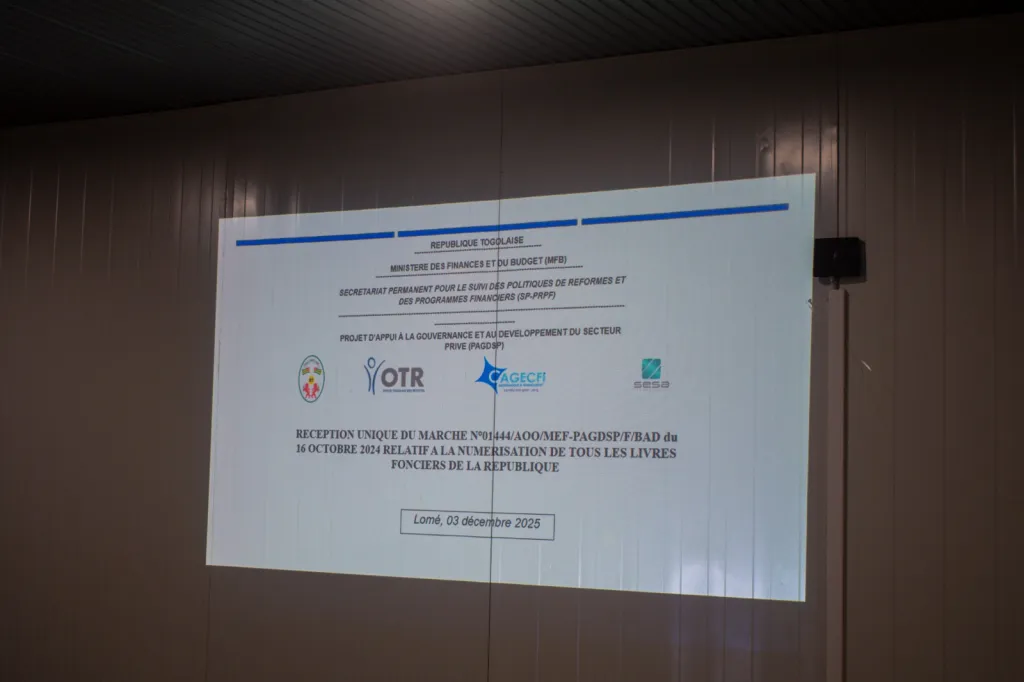
A major shift has quietly taken place within Togo’s public administration. Dusty registers and endless processing delays are now a thing of the past. As of December 3 in Lomé, all land registry books of the Republic of Togo have been fully digitized, marking a significant milestone in the country’s land governance reform.
This technological achievement was officially delivered by the CAGECFI – SESA TECHNOLOGIES consortium, representing a decisive step forward for land security and the overall business environment.

A Historic Moment for the OTR
The handover ceremony, held at the premises of the Directorate of Cadastre and Land Conservation (DCCF), will remain a landmark event in the history of the Office Togolais des Recettes (OTR). After several months of intensive work, the land registry digitization project has officially entered its operational phase.
The initiative was financed by the African Development Bank (AfDB) through the Project to Support Governance and Private Sector Development (PAGDSP). Its impact is expected to be immediate for both citizens and investors. Previously, accessing land title information was often cumbersome, relying on fragile physical records and incomplete digital tools. Today, these challenges have been replaced by a secure digital database and a streamlined professional application designed to ensure reliability and efficiency.
Addressing Long-Standing Administrative Bottlenecks
Speaking during the reception ceremony, Kwami Obossou, Director of Cadastre and Land Conservation, highlighted the limitations of the former system. According to him, obtaining accurate information on land titles was often difficult, with partial data and frequent returns to manual registers.
“The application we had was blocked. Whenever we needed information, we had to go back to the physical registers,” he explained, adding that the new digital solution now provides a concrete and lasting answer to these challenges.
In a clear sign of commitment to digital transformation, the administration has already suspended manual land title creation for the past two weeks, opting to move entirely toward electronic processing. Staff members have been trained and are fully operational.
A Technical and Human Feat
Behind this success lies an intensive operation led by CAGECFI SA, a leading Togolese IT engineering firm, in partnership with SESA TECHNOLOGIES, a Senegal-based specialist in digital archiving.
The scope of work went far beyond land registry books alone. The project also included the digitization of deposit registers, opposition records, and preliminary formality documents, supported by high-capacity production scanners operating continuously.
Particular praise was directed at the technical teams’ commitment. “This is the first time I have seen a service provider working 24 hours a day, seven days a week” noted Mr. Obossou. This level of dedication made it possible to meet deadlines and, when necessary, reprocess certain data to ensure complete accuracy and reliability.
A Strategic Lever for the National Economy
Beyond its technical dimension, the project represents a strategic asset for Togo’s economic development. Secure land tenure is a key determinant of a country’s business climate. By improving the reliability of property titles and accelerating transactions such as mortgages, transfers, and ownership changes, Togo strengthens its attractiveness to investors.
For Ms. Azangou Ange, Representative of the PAGDSP Coordinator, the outcome fully meets expectations. She expressed overall satisfaction, particularly from the software users who interact daily with the system.
What Comes Next?
Although the system has been officially delivered, the work is far from over. Kodjo Amèvo Houndjago, Chief Executive Officer of CAGECFI, confirmed that his teams will remain mobilized during the post-deployment phase. The next objectives include stabilizing operations and interconnecting the new land database with other OTR services through APIs, ensuring seamless circulation of fiscal and land-related information.
With this achievement, Togo takes a decisive step toward full e-government, demonstrating that public sector modernization can successfully rely on strong local and regional expertise.
About The Author